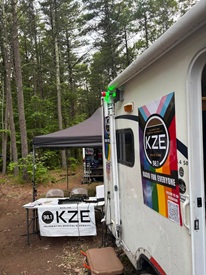
There is something wonderfully backwards about the KZE Kamper.
At a time when much of the radio industry is looking for ways to move farther away from the physical world—more automation, more centralized programming, more content delivered from studios hundreds or thousands of miles away—98.1 KZE has been investing in a vehicle designed to do exactly the opposite.
We built something that allows the radio station to go where the music is.
The KZE Kamper is a mobile live-music production and broadcast vehicle capable of recording, mixing, transmitting and producing concerts from virtually anywhere we can park it. Inside is much of the same technology that would traditionally be found in a professional broadcast facility or live recording studio: digital audio production, multitrack recording, broadcast communications, video capability and redundant internet and transmission systems using technologies including Starlink, cellular networks and professional broadcast codecs. That type of infrastructure is not normally sitting in the parking lot of an independent local FM radio station. The thing is, at WKZE, we’re just a bunch of audio geeks who like to think outside of the box.
For much of radio’s history, the station was a physical part of the community it served. Broadcasters did not simply talk about the places around them. They went there and they were part of the fabric of the every day life of their audience. You hit that pothole on Route 9 going to work this morning? Chances are the morning show guy did too. Radio station broadcasts from theaters, fairs, stores, schools, ballfields, festivals and town events used to be an everyday thing. Remotes were considered to be a staple of the industry. The medium worked because there was a tangible relationship between the people behind the microphone and the people listening to it.
Somewhere along the way, the industry forgot about what made radio special in the first place. The KZE Kamper is our attempt to move in the other direction.
My 2024 doctoral research examined the value of terrestrial FM broadcasting and, particularly, what happens when a radio station becomes more than simply another outlet for distributing audio. One of the recurring findings was that the presence of a real broadcast signal created a sense of legitimacy and credibility for the people creating the programming. The work became consequential because there was a real audience on the other side of it. As an aside, a large volume of this research was conducted in the Hudson Valley at WFNP, SUNY New Paltz’s radio station. The results of the research ultimately lead to the decision by my wife and I to purchase WKZE from the Stanley family and continue operating the station in its current form. We recognized the tremendous potential of 98.1FM as a live and local broadcast entity.
I believe the same principle applies to a local music community: if you really want to connect with your audience, you have to present live music! To get real results, that music needs to be captured and presented on an even larger stage.
There is an enormous difference between a band playing a great set in front of 150 people and that same band knowing the performance is being professionally recorded, broadcast over a regional FM signal, streamed to listeners elsewhere and potentially preserved as a piece of the Hudson Valley’s musical history. When you put audio up on an FM channel, you’re putting that magic into the air on the VHF band. Anyone within range of the station’s antenna can experience it. It’s pretty cool!
Now, this does not mean the musicians will perform differently because somebody parked a truck outside. It means the infrastructure surrounding their performance is finally treating their work with the significance it deserves.
An Old Radio Idea, Rebuilt for Local Radio
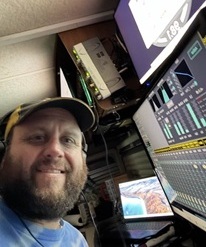
In some respects, there is nothing new about the idea behind the KZE Kamper. Not long ago, there was a period when radio took live music very seriously.
Beginning in 1973, the King Biscuit Flower Hour brought professionally recorded concert performances to radio audiences across the country. Produced by the D.I.R. Radio Network, the program became a Sunday-night ritual for rock listeners and, at its height, was heard on more than 300 stations. The production model was intensively physical: a mobile recording truck would park outside a theater or arena, connect to the performance, record the concert and prepare it for national radio distribution.
Westwood One built a similar legacy around location recording and the national distribution of live concerts and major music events. Long before a listener could pull out a phone and watch practically any performance on demand, radio networks invested substantial resources in bringing the experience of the concert hall to people who were not in the room.
This was incredibly unique and special for a number of reasons. You heard the room. You heard the crowd. You heard the imperfections. You heard that little moment before the first note when thousands of people realized something super cool was about to happen.
In this case radio was not being reactive. Radio was there, present and involved in the creative process.
What is unusual today is not the technology itself. Anyone can be a broadcaster these days. Just hold up your phone and stream and you’re on the air. But the product, usually a 45 second shaky video with unmixed audio pales in comparison to doing it as a large scale production. What is unusual is seeing that philosophy recreated by a small, independently owned local radio station.
The national networks had trucks, engineering departments, satellite distribution systems and the resources necessary to move sophisticated production equipment around the country. KZE is taking that same basic concept and shrinking it to the scale of the Hudson Valley. Instead of waiting for a nationally recognized artist to walk onto an arena stage, the Kamper can pull into a farm, theater, club or regional festival and apply professional broadcast infrastructure to the musicians playing here.
This highlights a very important difference, especially when applied to a local station like WKZE the rich, fertile ground of music and art constantly being cultivated in the Hudson Valley.
-A nationally syndicated concert broadcast demonstrates the power of a famous artist.
– A locally produced concert broadcast can help create the audience for an artist who is not famous yet.
For an independent radio station whose identity is built around musical discovery, that may be one of the most powerful things we can do to have an impact on our local market.
Building Infrastructure for Local Music
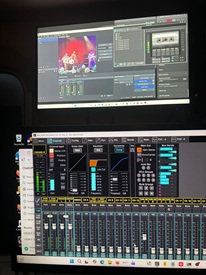
The Hudson Valley certainly does not suffer from a shortage of talented musicians. What local musicians often lack is infrastructure and traditional distribution. Professional mobile recording is expensive. Video production is expensive. Broadcast distribution is difficult. Hiring engineers, acquiring equipment and creating professional recordings can quickly become unrealistic for a band playing clubs, theaters, farms or regional festivals.
A radio station already occupies a unique position in that ecosystem. We have an audience. We have distribution. We have engineering knowledge. We have relationships with venues, promoters, musicians and listeners. The KZE Kamper allows us to connect all of those pieces together in a really fun way.
Starting this past may, WKZE has been able to arrive at a festival, connect to the stage, produce a professional broadcast mix, capture the performance, originate live programming and create audio and video assets that can continue living after everyone has gone home. We have been able to bring the stage right to the audience listening and watching at home That capability fundamentally changes what a small independent radio station can contribute to its community and to the greater arts, entertainment and cultural scene. We are no longer simply promoting the concert. We can become part of the concert.
And, more importantly, we can help make the concert larger than the physical space in which it is taking place.
Someone driving through Rhinebeck can hear what is happening on a stage miles away. Someone sitting at home in Red Hook can become part of a festival they could not attend. A listener discovering a local artist for the first time can hear that artist in the environment where music is often most powerful—live, imperfect, spontaneous and surrounded by an audience reacting in real time. The people standing in front of the stage are no longer the entire audience. They are the center of an audience that can extend across the KZE listening area and beyond via webstreaming. That creates a very different dynamic between artist, radio station and listener.
Radio as a Participant, Not an Observer
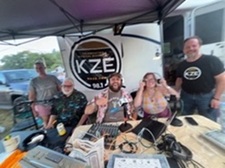
One conclusion I continue to draw from my research is that the long-term value of terrestrial radio will not be determined exclusively by the technology used to deliver the audio. Streaming is important. Apps are important. FM is important. Social media, video and podcasting are important. But distribution technology by itself does not create community.
Participation, reliability, quality control and listener discovery all drive engagement.
My research found that FM stations can develop deeper relationships with the communities surrounding them and that investment in broadcast technology, facilities and innovation can expand opportunities for engagement, collaboration and community support.
The challenge for local radio is to use all of these technologies to create experiences that national platforms cannot easily reproduce.
Spotify can play a record by a Hudson Valley musician. It cannot park next to a stage at a local festival, run cables from that stage into a mobile control room, put an engineer behind a console, capture the crowd, interview the musicians and send the entire experience back across a locally owned FM signal while the performance is happening. That is local radio using technology to do something distinctly local.
And there is another important consequence. Every time the Kamper records a performance, we have the opportunity to preserve a small piece of our region’s cultural history. Today’s unknown opening band may be tomorrow’s important artist. The performance happening on a farm, at a small festival or inside a local theater may never occur again in quite the same way. When we capture those performances properly, we are doing more than generating content. We are building an archive of a living music community.
The irony is that, in an age when virtually everything can be recorded on a phone, some of the most culturally important things happening in our own backyards can still disappear without ever being meaningfully documented. The Kamper gives KZE an opportunity to change that and leave a lasting impact.
It Takes Local Partners
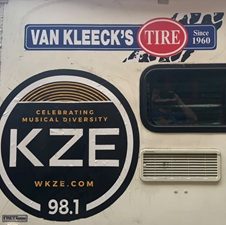
None of this works without businesses that understand the relationship between local media and local community. Van Kleeck’s Tire has stepped forward as a sponsor of the KZE Kamper, and I think the partnership makes particular sense.
There is something fitting about a Hudson Valley business that has been serving the region since 1960 helping keep a piece of mobile Hudson Valley radio on the road. I even love the slogan we came up with: “Van Kleek’s Tire and Auto Center – Keeping radio rolling since 1960! Clay and his family have been longtime supporters of the local radio industry and are avid live music fans. So this makes the relationship even more important. Their support helps KZE take this equipment out of the station and put it in front of stages, musicians and audiences throughout the region. Sponsorship in this case is not simply a commercial surrounding a piece of programming. It helps support the physical infrastructure that allows the programming to happen in the first place.
This is the real power of small enterprise partnering with local radio. When a local business supports a project like the KZE Kamper, it is helping a radio station invest directly in the cultural ecosystem from which all of us benefit. That relationship also reflects something else my research found: local businesses, community partners and other outside stakeholders can play an important role in supporting radio organizations and extending what those stations are able to accomplish.
In this case, the result is pretty tangible.
Put fuel in the truck. Put tires underneath it. Put engineers and equipment inside it. And go find some music. Get it on the air and let the FM do the rest of the work. The VHF signal exists in the air around us. Anyone can access it, with no paywall. It transmits in stereo and when you get that stage audio running over that small piece of metal sitting high above the ground on the 98.1 tower, something really magical happens. You’re charging the electricity in the airwaves with local music!
Wherever the Music Happens
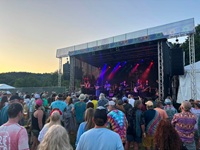
I do not believe the future of local radio is going to be found by attempting to become a smaller version of a national streaming service. We will never win that race, nor should we try.The advantage local radio still possesses is contained within the word local. We can know the musicians on a personal level. We can develop relationships with the venue owners and call them up with ideas for shows. We can see the people standing in front of the stage. We can recognize the road we’re driving down and understand why the concert happening at the end of that road matters to the community around it. And now, we can bring the radio station with us. That is what makes the KZE Kamper exciting to me. In one sense, it is a new piece of technology for KZE. In another, it is a return to one of radio’s best ideas. King Biscuit did it. Westwood One made a legacy out of it. Some of the greatest live performances in radio history were captured because broadcasters believed there was value in getting out of the studio, parking a truck next to a venue, plugging into the stage and putting the listener inside the room.
We are simply asking what happens when an independent local station applies that same philosophy to the musicians, festivals and audiences in its own backyard. The Kamper is a truck filled with an admittedly unreasonable amount of technology. But the technology is not really the story. The exciting part what that technology allows us to do. It allows a small independent radio station to create a professional production platform for local musicians. It allows a concert audience to become part of a broadcast. It allows listeners miles away to experience something happening in their own community. It allows performances to be captured and preserved. And it allows KZE to support the people who actually create the music around which our radio station has been built.The KZE Kamper represents a simple idea about what local radio can still be.
Plus, my wife and business partner at WKZE Katie loves the camper. There’s always a fridge filled with cold beer, snacks, a microwave, a shower and a comfy bed to sleep in when she gets tired. We’ve already done 6 live broadcasts together this summer, ranging from Froggy Daze in Narrowsburg PA, to The Dead of Summer Music Festival with our friends at WEQX in Vermont to Grey Fox in the Catskills, Moon Bloom in Coeymans Hollow and even our own show at Hardeman Orchards this past weekend. And we still have another 6 or 7 to go before the end of the season. All live, independent concerts featuring dozens of local bands. There’s no better way to spend the summer if you love audio and music.
I would be remiss if I didn’t mention another important factor that makes the Kamper successful: having a good FOH engineer and stage tech. My production partner David Chapman, one of the finest audio engineers and I agreed that the recordings from John Hardeman’s barn were some of the best we’ve ever done together. For me, having a partner like Dave running front of house gives me one less thing to worry about, since I know what is coming to the Kamper from the stage is of the highest quality. And of course, having some of the best bands in the Hudson Valley performing in real-time doesn’t hurt either.
So this summer, I ask all of you music fans to do me a huge favor. Don’t just tell people where the music is happening. Go there. Grab a drink, stay off your phone (unless you’re taking pictures or video) and enjoy being present while history is made. Don’t forget to bring your friends – the artists will thank you for it. And if you can’t make it to the show, know that you can find it on your local radio station, 98.1 WKZE!
Honk if you see the KZE Kamper on the highway this summer. If it’s a Friday, chances are we’re off to go bring you the best concert of the weekend! And if you happen to swing by Van Kleek’s, find Clayton or any other member of the staff, shake their hand and thank them for supporting live and local music!
The KZE Kamper is sponsored by Van Kleeck’s Tire of Lake Katrine.
Dr. Andy Gladding is the Co-Owner of 98.1 WKZE along with his wife Kathleen Berghorn
He is the Chief Engineer for Salem Media of New York as well as an adjunct professor of audio at Hofstra University.
MendoWerks would love to hear from you! Submit your music now for a review.
About Author
